

Breathing
Breathe through your nose
“The missing pillar in health is breath.”
- Your sinuses release nitric oxide into every nasal breath — a natural vasodilator. Nestor puts it at roughly six times more nitric oxide through the nose than the mouth. Source: Nestor, Pulmonology Advisor interview.
- In a Karolinska Institute study, healthy adults had 10% higher blood-oxygen readings breathing nasally versus orally. Source: Lundberg JO et al., Acta Physiologica Scandinavica 1996;158(4):343–347.
- Nasal strips lower nasal airflow resistance by widening the nasal valve — strongest effect in people with naturally narrow or congested passages. Source: Kirkness JP, Wheatley JR, Amis TC. European Respiratory Journal 2000;15(5):929.
- Nestor's Stanford self-experiment — ten days of forced mouth breathing, then ten days nasal — produced snoring and disrupted sleep on the mouth-breathing phase, both of which stopped when he switched back to the nose. Source: Breath (2020); Nestor interview, Pulmonology Advisor.
“Mouth breathing during sleep is not just undesirable; it is actually dangerous.”
The nose filters, warms and humidifies every breath. The mouth does none of it.
- In a study of mouth-breathers with mild sleep apnoea, taping cut the median snoring index by roughly half. Source: Lee YC et al., Healthcare (Basel) 2022;10(9):1755.
The answer

Mouth Tape
Promotes nasal breathing all night. Central vent slot, so nothing feels sealed shut.
See the mouth tapePrefer them together? That combination is the Breathing Ritual.
Darkness
Sleep in real darkness
“We are a dark deprived society. We get what I call 'junk light' at night.”
“Junk light” is his own coined term — it names the exact problem light in the bedroom creates.
- Walker cites a study where dimming lights below 30 lux for 90 minutes before bed — and cutting the blue out — increased REM sleep by 18%. Source: The Diary of a CEO, November 2025 — same episode.
- Melatonin is suppressed by very little light: in one study the average level that halved melatonin was about 24 lux, roughly a dim lamp. Source: Phillips AJK et al., PNAS 2019;116(24):12019.
- Walker's QQRT framework rates quality — sleep continuity, i.e. unbroken stretches — as mattering as much as quantity. Light that wakes you fragments exactly that.
- A 2023 trial found people encoded memories better and were more alert the day after sleeping in an eye mask. Source: Greco V et al., Sleep 2023;46(3):zsac305.
The answer

Contoured Silk Sleep Mask
Total blackout. Zero eye pressure — the cups don't touch your eyes or lashes.
See the sleep maskSilk
Sleep on silk
No expert quote here — this one wins on material fact.
- Independent textile testing (TRI Princeton) shows silk has a lower friction coefficient against hair than cotton — less snag, less tug, less mechanical breakage.
- Silk absorbs less moisture than cotton, so it draws less of your skincare and skin moisture away overnight.
- 22 momme. Momme is the objective weight measure of silk density — 1 momme ≈ 4.34 g/m². Most “premium” silk sits at 16–19. Publishing the number is a check competitors can't fake.
- OEKO-TEX® STANDARD 100, Product Class I — cert SH025 240363, TESTEX. Class I is the strictest tier, the one applied to products for babies.
The answer
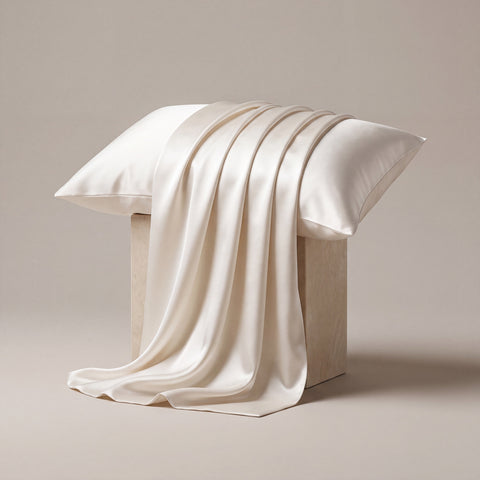
Silk Pillowcase
Frictionless — less breakage, fewer tangles. Helps skin hold moisture overnight.
See the pillowcasePair it with the contoured silk sleep mask — together they are the Silk Ritual.
Not sure where to start? Take the Sleep Score Test